
Heliport projects · Surface-level and elevated
A pilot on your heliport project.
Technical consulting and project management for onshore heliports, for construction companies, hospitals and private owners. I check the project against the standards and from the cockpit, and I keep it on track.
Standards I work with
ICAO Annex 14 Vol. II · ICAO Doc 9261 · EASA CS-HPT-DSN · ENAC heliport regulation · FOCA guideline for hospital landing sites
Services
What I do on a heliport project
Requirements check
Your project against the applicable standards, clause by clause. You get a table: requirement, source, status, open point.
Operational review
Approach and departure paths, obstacles, wind and turbulence, rotor downwash, performance class, and the helicopters that will really use the site.
Project management
PRINCE2-certified management for builders and owners: plan, risks, and the interfaces with designers, suppliers and the authority.
Owner’s representative
Independent from manufacturers and suppliers. I work for you, not for a product.
Swiss hospital landing sites
Gap analysis against the FOCA guideline for hospital landing sites, in force since May 2025. In Italian or English.
Construction support
Answers from the pilot’s point of view while you build: cranes, roof details, lighting, markings, safety nets.
Inside a heliport
What I look at on your project
Pick an element to see what it is and what I check. The plan is simplified and not to scale.
TLOF
Touchdown and lift-off area (TLOF)
The load-bearing area where the helicopter touches down and lifts off.
What I check
- Size and strength for the design helicopter
- Surface, slope and drainage
- Markings and lighting
ICAO Annex 14 Vol II · Doc 9261 · EASA CS-HPT-DSN
FATO
Final approach and take-off area (FATO)
The area over which the helicopter completes its approach to a hover or landing, and from which it starts the take-off.
What I check
- Size for the helicopters and the way they will fly
- Obstacles around it
- How it relates to the TLOF
ICAO Annex 14 Vol II · Doc 9261 · EASA CS-HPT-DSN
SA
Safety area
An obstacle-free area around the FATO that reduces the risk of damage to a helicopter that drifts off it.
What I check
- Width and surface
- Which objects may stand in it, and how high
- Frangible mountings
ICAO Annex 14 Vol II · Doc 9261 · EASA CS-HPT-DSN
TDPM
Touchdown/positioning marking
A circle painted on the TLOF. With the pilot’s seat over the line, the undercarriage is inside the TLOF and the helicopter clears obstacles by a safe margin.
What I check
- Diameter and position
- Colour and visibility from the cockpit
ICAO Annex 14 Vol II · Doc 9261 · EASA CS-HPT-DSN
APP/TO
Approach and take-off climb surfaces
Sloping obstacle limitation surfaces that protect the paths into and out of the heliport. Nothing should stick through them.
What I check
- Obstacle survey along the paths
- Slope and width for the operation
- Future buildings and cranes
ICAO Annex 14 Vol II · Doc 9261 · EASA CS-HPT-DSN
WDI
Wind direction indicator
Shows the pilot on approach the wind over the FATO and TLOF. It goes where nearby structures do not disturb the airflow around it.
What I check
- Position and visibility
- Lighting for night operations
ICAO Annex 14 Vol II · Doc 9261 · EASA CS-HPT-DSN
LIGHTS
Lighting for night operations
The lights that let a pilot find the heliport at night, see the FATO and the TLOF, and judge the approach: perimeter lights, floodlights, a heliport beacon and, where needed, approach lights.
What I check
- Which lights the operation needs, and where they go
- Colours, spacing and intensity against the standard
- Floodlights that light the TLOF without dazzling the pilot
- A lit wind direction indicator and lit obstacles
ICAO Annex 14 Vol II · Doc 9261 · EASA CS-HPT-DSN
RFF
Rescue and firefighting
The equipment, extinguishing agents and people ready to act if something goes wrong on the heliport. What is needed depends on the largest helicopter that will use it, and on where the heliport is: at ground level or on a building.
What I check
- The heliport firefighting category, H1, H2 or H3, from the helicopters you plan for
- Extinguishing agents, quantities and discharge rates
- Where the equipment stands and how fast it reaches the FATO
- The emergency plan, the people and their training
ICAO Annex 14 Vol II · Doc 9261
MANUALS
Heliport manual and safety management manual
The two documents the authority usually asks for before a heliport goes into operation. The heliport manual describes the site, its facilities and how it is operated and maintained. The safety management manual sets out how hazards are identified, how risks are assessed and how safety is monitored over time.
I can write both manuals for you, or support your team while it writes them.
How I can help
- Writing the heliport manual: the site, its facilities, operating procedures and maintenance
- Writing the safety management manual: safety policy, hazard identification, risk assessment and safety monitoring
- Supporting your team: structure, templates and a review of each draft
- Matching both manuals to the applicable rules and to how the heliport will really be operated
ICAO Annex 19 · ICAO Doc 9859 · national heliport rules
On the drawings
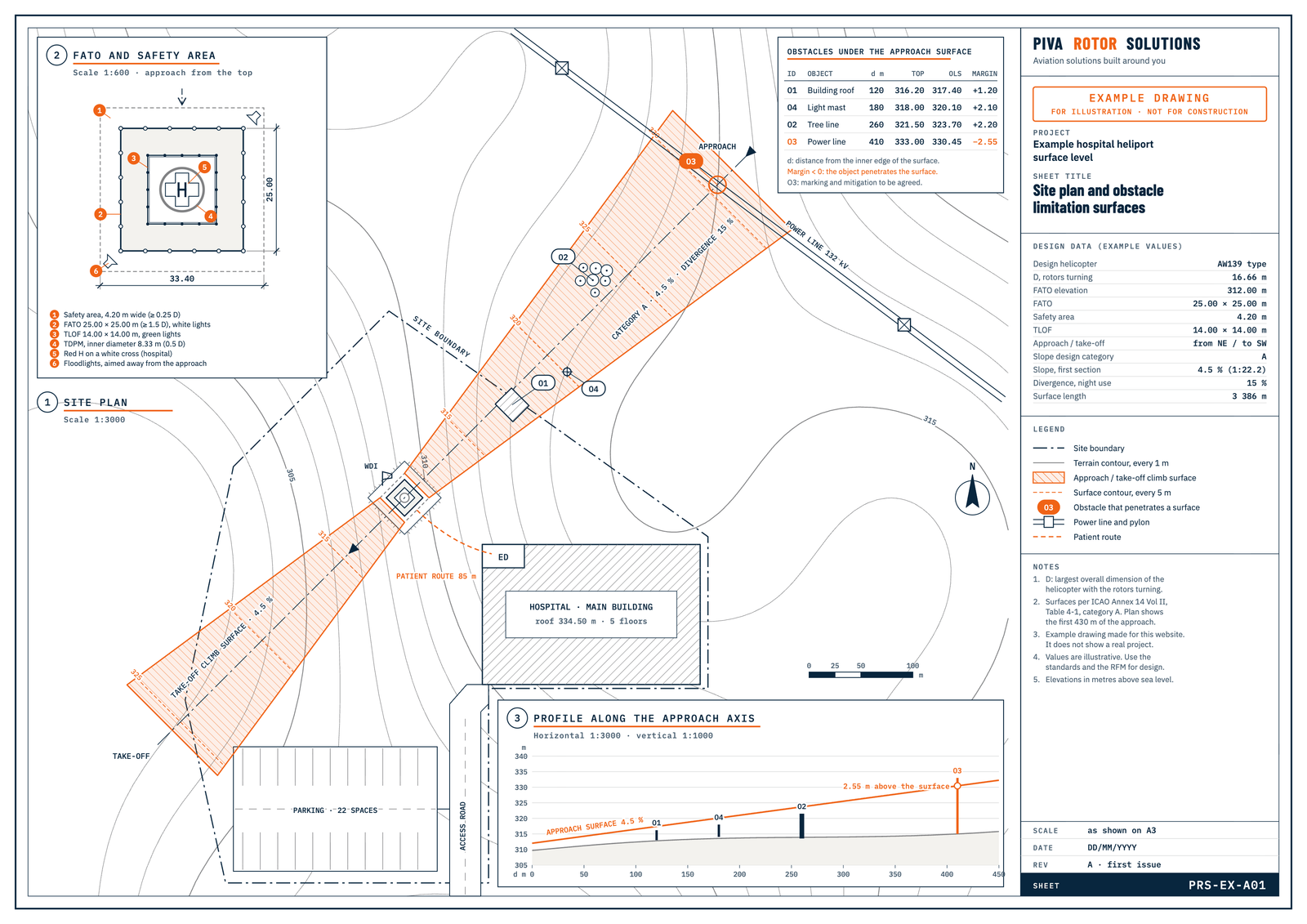
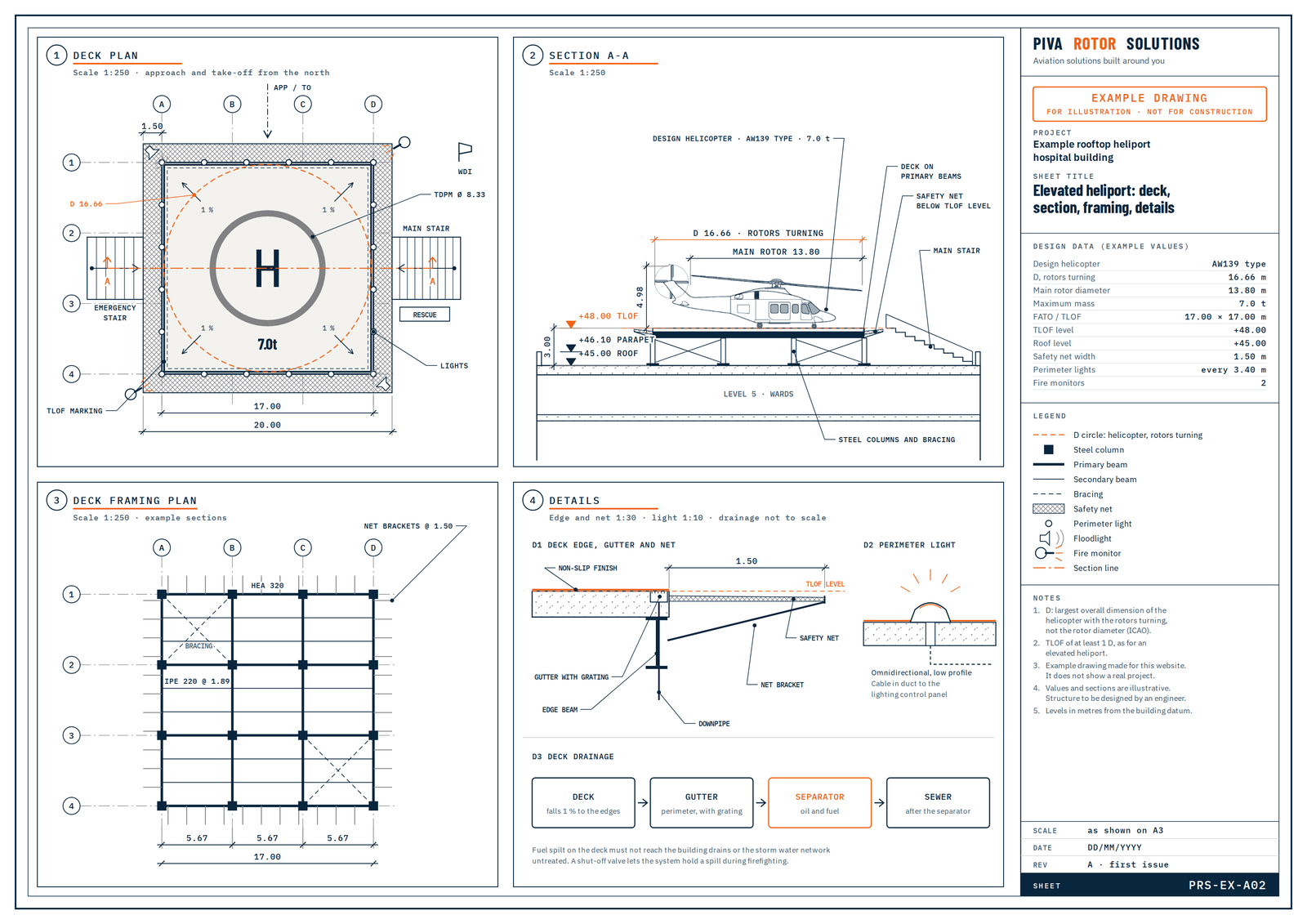
Every element above ends up on a drawing. Two example sheets, drawn for this page, show where.
How a project runs
Scope in writing before anything starts
- First call, free. The site, the helicopters it must serve, your deadlines.
- Written scope. What I check, what I deliver, a fixed fee per phase.
- Requirements and review. The table, the operational review, the open points.
- Through construction. Support and project management until handover.
- Handover. The documents you need for the operator and the authority.
What this is not. Detailed design, structural calculations and certification documents are signed by qualified engineers, and approvals are issued by the competent authority. I advise, check, review and manage.
Working on a heliport?
Tell me where it is, which helicopters it must serve and where the project stands. The first call is free.